
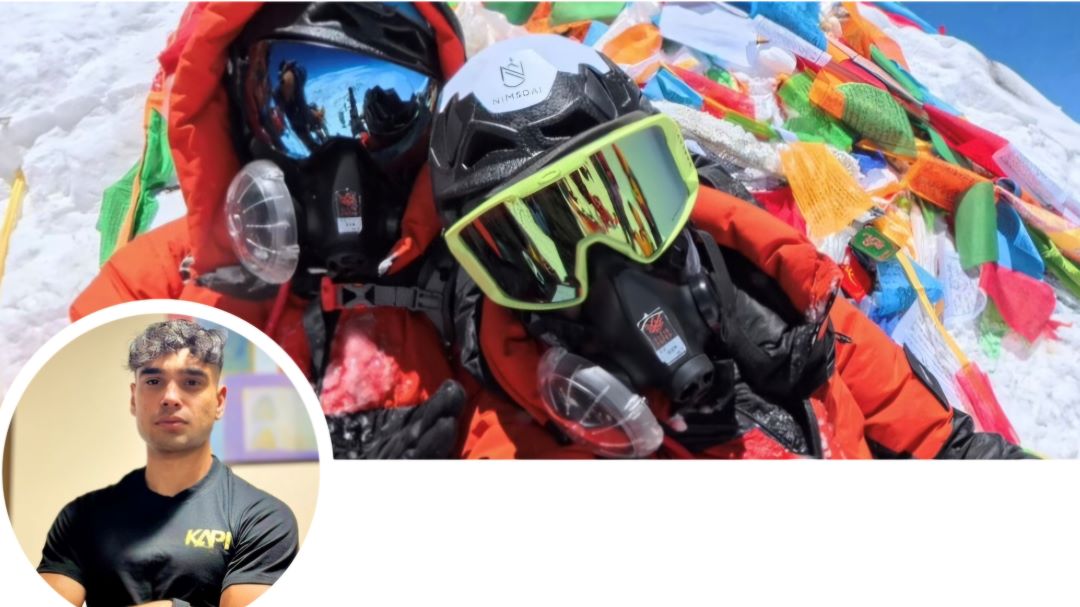
From football ambitions to mountaineering
Shayeet Sharma is a 26-year-old sports performance coach based in Leeds, but his story begins in Nepal. He came to Leeds to study Sport and Exercise Science at Leeds Beckett University, with his sights set not on mountains but on football. He played semi-professionally and hoped to progress into the higher divisions in Europe, but, as he explained to the Rotary Club of Roundhay, “Unfortunately, because of my passport, because of visa rules and regulations, I couldn’t compete.”
It was a setback that took his life in an entirely different direction. His cousin, Sudhigya Pant, suggested they should try something different, and in 2025 the pair climbed a 6,000-metre peak in Nepal. It gave Shayeet his first serious experience of mountaineering and taught him the practical skills he would need, including using crampons and ice axes and coping with high altitude.
“We thought, okay, we’ve already done a 6,000-metre peak — let’s go for something big.”
A climb with a wider purpose
That “something big” turned out to be Mount Everest. But the pair wanted the expedition to have a purpose beyond simply reaching the highest point on Earth.
“It was not about just doing Everest,” Shayeet explained. “Let’s do something unique — that also helps society in a meaningful way.”
On 20 May 2026, after months of preparation and 41 days in the Himalayas, Shayeet stood on the summit at 8,848.86 metres.
£50,000 — and convincing his parents
Funding the expedition
Everest was not simply a matter of deciding to go. Shayeet estimated that the expedition cost around £50,000, money he had been saving for three years, with help from his parents and sponsors in Nepal.
Winning family support
Getting his family to agree was another challenge. His mother was working on a UN project in Fiji while his father was in Nepal, and initially they refused to support the expedition. Shayeet explained that he wanted to use the opportunity not only to climb Everest but also to launch a fitness clothing business and support projects that would benefit other people.
Eventually, he told his mother that he had already bought his flight tickets and needed the paperwork returned within five or six days. It was, he said, one of the hardest parts of making the expedition happen.
Nine days to Base Camp — then nearly a month waiting
The journey from Lukla
The journey from Lukla to Everest Base Camp took nine days. Shayeet described the small mountain airport and the experience of flying in poor weather, with the aircraft shaking as it approached the short runway.
At Base Camp, 5,364 metres above sea level, the team then faced a very different problem: waiting. Conditions in the Khumbu Icefall were too unstable to continue safely, with large blocks of ice known as seracs capable of breaking away without warning.
The team spent around 30 days at Base Camp, training, preparing equipment and waiting for a safe opportunity to move higher. At night, the sound of falling ice and rock was a reminder that the mountain was never completely still.
Through the Icefall
When the route finally opened, the team crossed the Khumbu Icefall using ladders and fixed ropes between towering walls of ice. Camp 1 was around 6,100 metres, Camp 2 around 6,800 metres and Camp 3 roughly 7,300 metres.
To his surprise, there was even a dining tent and Wi-Fi at Camp 2. By Camp 3, however, the effects of altitude were becoming much more obvious. Oxygen was introduced, and Shayeet described what happened when he briefly disconnected his supply: “Within a few seconds, your muscles are burning.”
The final push
Leaving Camp 4
Camp 4, at around 8,000 metres, was the starting point for the summit push. Shayeet and his cousin left at around 11pm, joining a long line of climbers making their way towards the summit by headlamp.
He remembered around 279 people being on the summit route that day; official figures recorded 274 successful summits from the Nepal side on 20 May, making it the busiest summit day of the season.
The Hillary Step
The most difficult delay came at the Hillary Step, where the route narrows and climbers have to move carefully, often one at a time. Shayeet and his cousin waited for around four hours as descending climbers were given priority.
During the wait, the cold became increasingly difficult to manage. His heated glove battery ran out and his hands began to freeze. He and other climbers were shouting, clapping and moving their hands to keep the blood flowing. Around them were exhausted climbers, and some bodies remained on the mountain.
Eventually the queue began moving again.
8,848.86 metres
Reaching the summit
After around 12 hours of climbing from Camp 4, Shayeet reached the summit at about midday.
He described the feeling simply: “I was very, very, very tired.” The altitude was taking its toll and his muscles were burning, but he had reached the highest point on Earth.
He spent around 40 minutes on the summit, taking photographs and recording material for the launch of KAPI, the fitness and outdoor clothing business he had developed with his cousin.
But for Shayeet, the summit photograph was only part of what the expedition was intended to achieve.
More than a summit photograph
The purpose behind KAPI
KAPI was conceived around the ideas of discipline, hard work and consistency, but Shayeet also wanted the business to have a social purpose.
He was born with clubfoot and underwent surgery as a young child. He described himself as fortunate to have received the treatment and support that enabled him to pursue his ambitions, and wanted the business to help others in similar situations.
KAPI’s plans include directing part of its revenue towards clubfoot treatment and supporting cataract surgery through its Summit to Sight initiative.
“I wanted to give something back,” Shayeet said.
That wider purpose was also reflected in the recognition he received following the expedition from the Government of Nepal.
The summit was only half the journey
A difficult descent
Getting down the mountain proved almost as demanding as getting up it. Shayeet spent around 27 hours making the journey from Camp 4 to Camp 3, with roughly 25–26 hours without proper food or water.
He had used much of what he had carried on the way up, including chocolates, energy bars and water. Eventually a Sherpa left apples and juice for him at Camp 3, helping him recover enough to continue.
Frostbite and weight loss
He lost around 8kg during the expedition and suffered frostbite to his face and toes. Damaged tissue and nails had to be removed, and he lost feeling in one of his toes for around a month. Some sensation has gradually returned, although his toenails have still not fully grown back.
Looking back, he said much of the descent became a mental battle. The body was exhausted, but he had to keep making the next step.
The questions afterwards
Safety and summit queues
The Q&A brought out some of the practical realities of the climb. Asked about the four-hour wait at the Hillary Step and whether the queues made the summit push unsafe, Shayeet explained that the weather window can be only a couple of days and climbers have invested huge amounts of money and training to get there. Ultimately, each climber has to decide whether it is safe to continue.
Everest’s environmental impact
He was also asked about the environmental impact of Everest. The amount of rubbish around the higher camps was difficult to ignore, he said, and if he returns he would like to organise a project specifically to help clean up the mountain.
What next?
Future climbing plans
Shayeet had originally hoped to follow Everest with an attempt on K2, again through Elite Exped, the expedition company associated with Nirmal “Nims” Purja. Those plans are currently on hold following Purja’s death on Broad Peak in July 2026.
A 24-hour run in Leeds
His next challenge is closer to home: a 24-hour run in Leeds to raise money for Macmillan.
It is a long way from the football ambitions that first brought Shayeet to Leeds. But the unexpected turn in his life has taken him from a 6,000-metre peak in Nepal to the summit of Everest — and towards a different ambition: to take on difficult challenges while using them to do something meaningful for other people.