
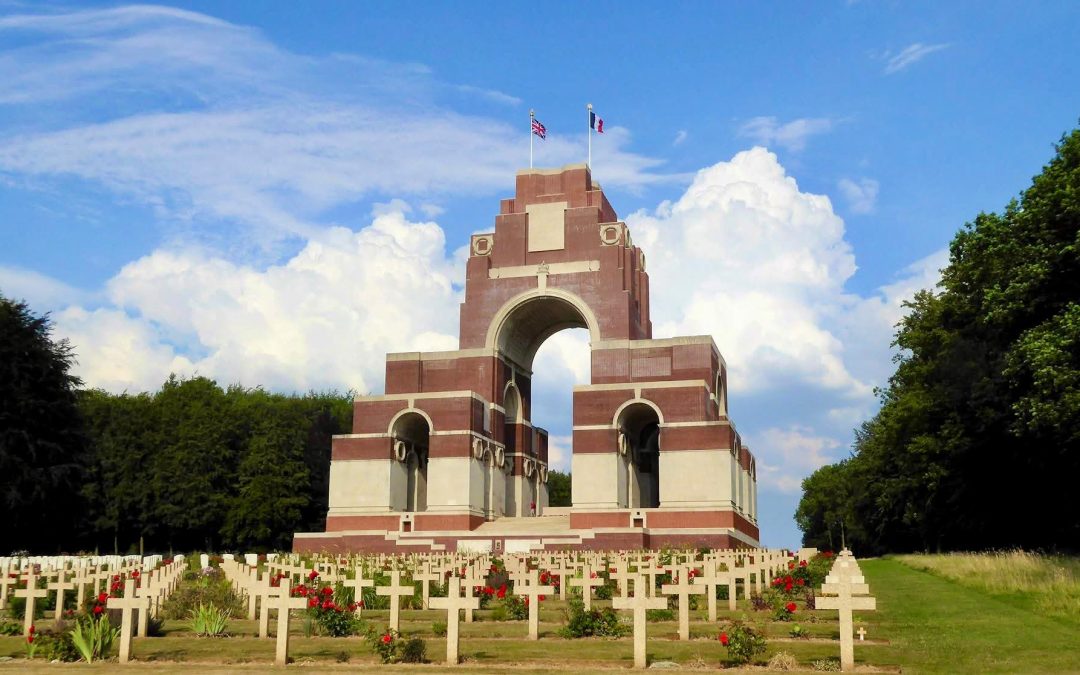
Brian Joyce explores the work of the Commonwealth War Graves Commission — with a poignant connection to Leeds
From Leeds to war cemeteries around the world, the stories of those who died in the two world wars are closer to home than we might think. At a meeting of the Rotary Club of Roundhay, Brian Joyce, a volunteer speaker with the Commonwealth War Graves Foundation, the charitable arm of the Commonwealth War Graves Commission (CWGC), gave an illustrated talk on the architecture, history and conservation of these places of remembrance.
His presentation brought the subject close to home through the story of Arthur Louis Aaron VC, a former Roundhay School pupil whose bravery cost him his life at just 21.
1. A global commitment to remembrance
Established in 1917, the CWGC commemorates approximately 1.7 million servicemen and women who died in the two world wars, across more than 150 countries and territories.
Brian illustrated the scale of its work, from Tyne Cot Cemetery in Belgium, with almost 12,000 graves, to small burial grounds containing only a handful. For unidentified casualties, the poignant inscription “Known unto God”, associated with Rudyard Kipling, ensures they are not forgotten.
The guiding principles remain equality, dignity and care in perpetuity, regardless of rank or background.
2. Designing the cemeteries
Sir Frederic Kenyon’s influential 1918 report helped establish a distinctive design: orderly rows of headstones, gardens, boundary walls and registers.
Two iconic features became symbols of the Commission’s work: Sir Edwin Lutyens’ Stone of Remembrance, inscribed “Their Name Liveth For Evermore”, and Sir Reginald Blomfield’s Cross of Sacrifice.
Yet the designs also reflect local cultures. At Neuve-Chapelle in France, Sir Herbert Baker incorporated Indian architectural influences to honour Indian servicemen.
3. Architecture around the world — and a Leeds connection
Brian explored celebrated memorials including Thiepval, Tyne Cot and the Menin Gate at Ypres, showing how architects adapted a shared philosophy to different landscapes and histories.
He also described how the discovery of approximately 250 British and Australian servicemen in Italy in 2009 led to a new cemetery, unveiled in 2010. The search for missing casualties continues today.
The talk’s most poignant local story was that of Arthur Louis Aaron, a former Roundhay School pupil awarded the Victoria Cross for bravery during a bombing mission over Turin in 1943. Severely wounded, he helped his crew before their aircraft landed in Algeria. He died nine hours later, aged just 21.
Aaron is remembered as Leeds’ only Victoria Cross recipient of the Second World War. A statue of him was unveiled in 2001 on a roundabout near Leeds Playhouse, following a public vote organised by Leeds Civic Trust. Brian asked how many people pass it without noticing — a reminder that remarkable local stories can be hiding in plain sight.
4. Conservation: keeping the promise
Weathering, fading inscriptions, flooding, fire and conflict all threaten memorials. Brian explained how the CWGC has learned from earlier repairs, increasingly using appropriate materials and traditional techniques. Re-engraving worn headstones can preserve original stone and reduce replacements.
The Menin Gate restoration was completed in 2025, ahead of the centenary of its unveiling in 2027. Conflict continues to disrupt conservation, including the CWGC’s work in Gaza. Brian also highlighted efforts to address historical omissions in the commemoration of Indian and African service personnel.
5. Keeping the stories alive
Brian encouraged the audience to share family histories, photographs and recollections through the CWGC’s online resources, helping bring the names on memorials to life.
Closer to home, Lawnswood Cemetery in Leeds contains CWGC graves and the Stuart family memorial, commemorating five sons lost. Stonefall Cemetery in Harrogate offers another opportunity to explore this history
A lasting legacy
Brian’s talk showed that the CWGC’s work goes beyond architecture and conservation. From monumental memorials overseas to the grave of a young airman from Roundhay, each site represents an individual life and a promise to remember.